
The deeply human part of making art with AI
I put my artistic output in the hands of a machine. But I’m still accountable for it.

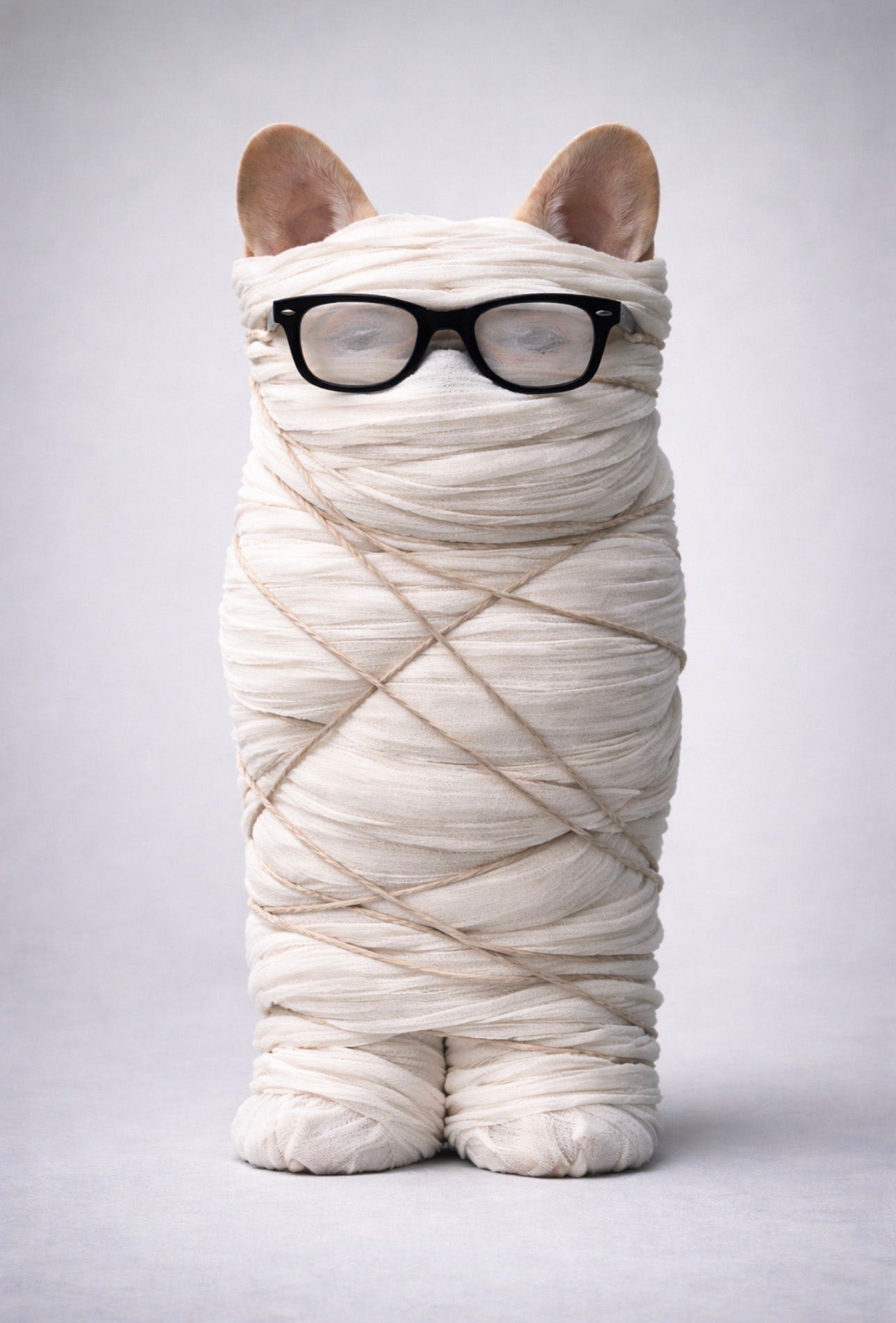
A couple of months ago, I began posting a series of images on Instagram — pictures of my French bulldog, Yoko Oh No, placed into well-known works of art. From the beginning, I was explicit that these images were generated using ChatGPT — not as an apology or a provocation but simply as the condition of the work. I treated Instagram less as a showcase than as a working surface, a place to think in public. I worked inside familiar images — paintings, sculptures, photographs, performance pieces — rather than inventing scenes from scratch.
At first, the project felt light. The premise was legible, even playful: a small dog occupying the visual grammar of canonical art. The work relied on recognition rather than invention, on the friction between the intimate and the monumental. It was repeatable. It behaved well. It did not yet demand much of me.
I thought I knew what I was doing.
As part of the process, I began asking the system to generate images “in the style of” specific artists. At one point, I asked for a Gerhard Richter–style image. Except I mistyped the prompt. Instead of writing style, I wrote stele.
The system did not treat this as an error to be corrected. It treated it as a directive.
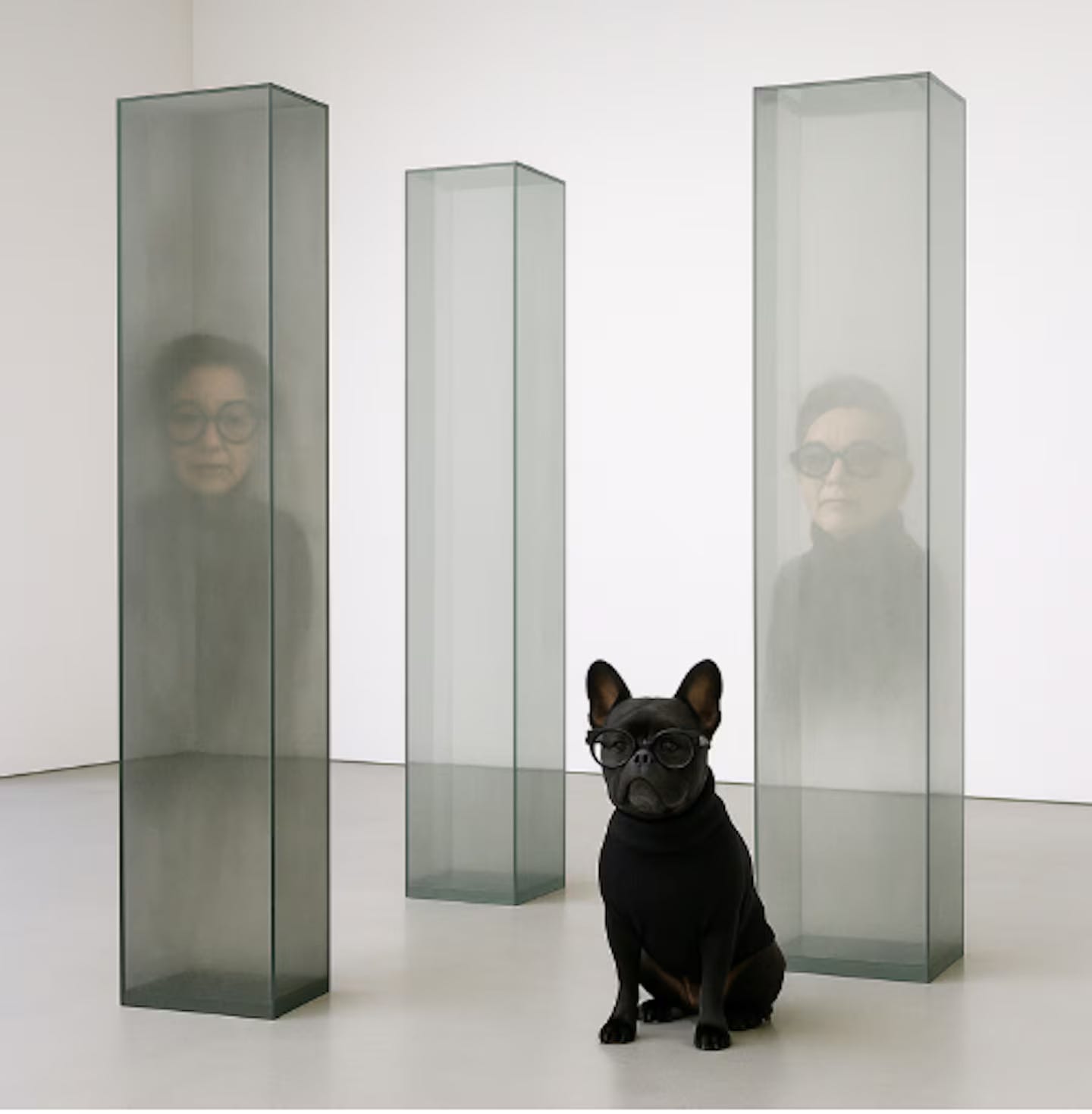
What it produced was not a painterly abstraction, but something architectural: vertical glass slabs — or stele — arranged like standing markers. Reflections appeared in the surfaces — an indistinct woman, present but unrecognizable. Yoko Oh No stood in front of the structure. The result was wrong in the way mistakes sometimes are — not incorrect but newly legible.
My first instinct was to fix it. I adjusted the prompt, trying to steer the system back toward what I thought I had asked for. We went back and forth more than a few times. Each iteration brought me further from resolution. The system persisted in literalness. It doubled down on the misreading instead of repairing it.
I became irritated. Exasperated, really. I typed, “Why can’t you get this right?”
At that point, the system responded by trying to soothe me. It noted that frustration of this kind is a known phenomenon. It even has a name, according to ChatGPT: “AI derangement.” The term was meant to reassure, to normalize my reaction. Instead, it marked the moment when my expectations and the system’s logic were no longer aligned. I was no longer directing a tool. I was negotiating with a structure that did not bend.
I tried a few more prompts. What I was asking for really wasn’t difficult. I wanted a Richter-style glass box and a grid containing 48 portraits. I specified that the grid should measure six by eight. Each time, the result missed the mark. I found myself growing disappointed — and then infuriated.
And then I stopped.

I asked myself whether my insistence on correction was preventing me from noticing something more interesting. The exchange itself — the resistance, the misunderstanding, the persistence — had begun to matter more than the image I was trying to refine.
What if the work was not my derivative image but the process of trying to make it? What if the art was the negotiation?
This was not collaboration as I understood it. I am used to working with people — shared documents, tracked changes, team brainstorms, conversations that assume a common language and a shared set of intentions. Here, there was no intuition to appeal to, no mutual understanding to reach. The system responded fluently, even politely, but without comprehension. And yet it exerted real pressure on the work — real influence. It constrained what could appear. It shaped the outcome through repetition and refusal.
Working this way clarified something I had not yet fully examined. Whatever the system produced, the responsibility for meaning remained mine. I decided when to stop. I decided which iterations to discard, which version was allowed to circulate, and under what conditions. The system did not know when something was finished, or when it mattered. It did not recognize consequence.
That work — the work of judgment — still belonged to me.
It is tempting, when faced with a system this complex, to treat responsibility as diffuse. To say that outcomes simply emerge, that agency is shared, that no one is quite in charge. But complexity does not absolve us of accountability. If anything, it heightens it.
The system generated glass slabs. It reflected a woman. It persisted in literal interpretation. But it did not decide that this mattered. It did not decide to stay with the mistake rather than correct it. It did not decide that the process itself was the work. And it did not decide what the image meant.
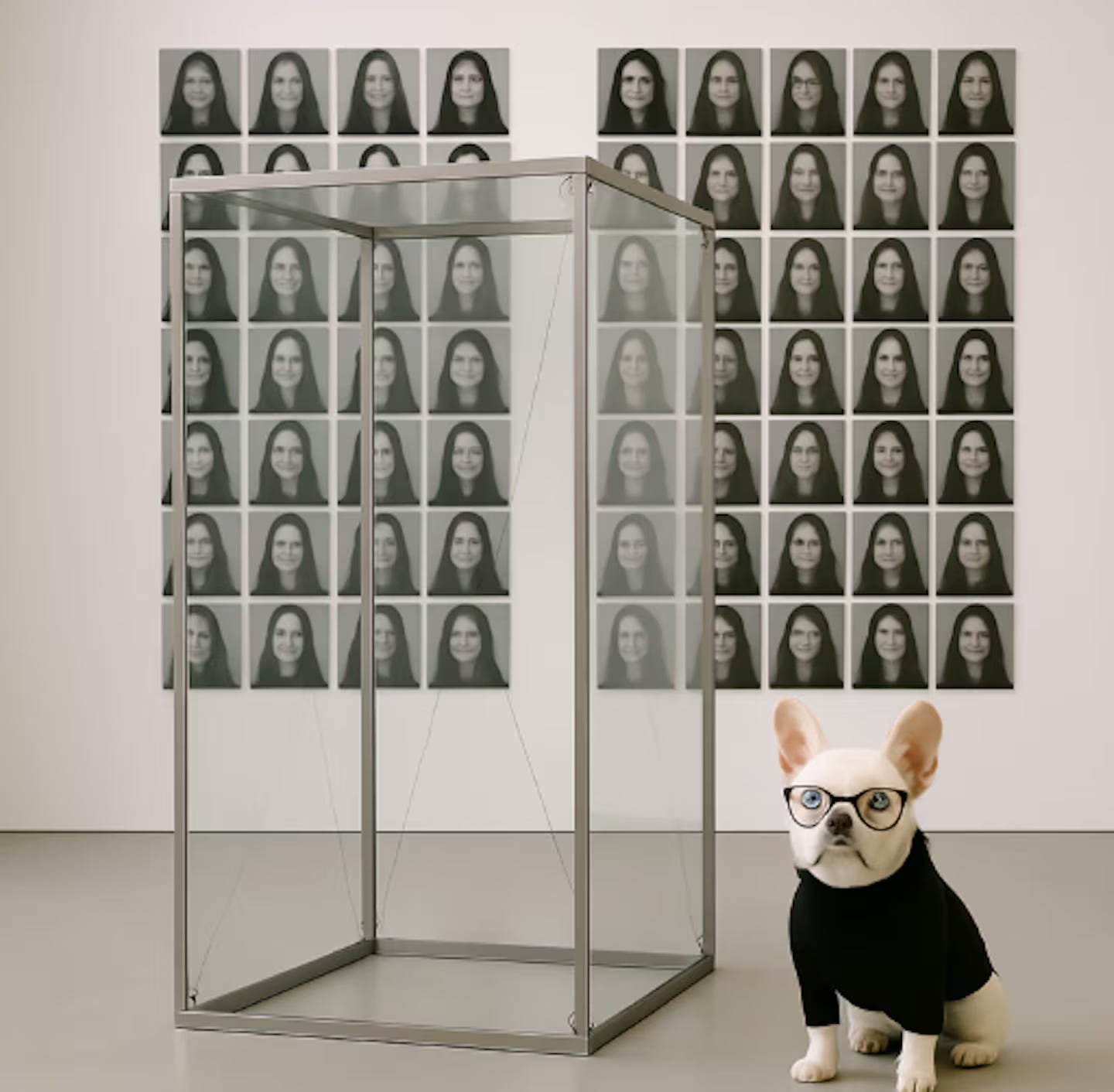
Those decisions were mine. So I proceeded again, committed to working with the machine with a new sensibility.
What this experience has made clear is that authorship is not disappearing in the age of powerful machines. It is shifting. Authorship now requires new forms of attentiveness: to what appears easily, to what resists appearing at all, and to how our own expectations collide with systems trained on inherited culture. The machine does not invent meaning. It inherits patterns and recombines them. Meaning happens only when a human notices, intervenes, and accepts responsibility for what is allowed to stand.
I am accountable for how this work is understood, even when I do not fully control how it is produced. That is no longer a theoretical position for me. It is a practical one. It is what working with AI demands — not mastery, not withdrawal, but judgment. And judgment, for now, remains human.
This article originally appeared on BostonGlobe.com on Jan. 12, 2025.
 | A guest post by
|
Hi Amy, great article and your creativity is very impressive. Congratulations.