
Elizabeth Warren wants a ‘big tent’ party — but only on her terms
Democrats will have to be flexible on social issues to win new voters.

The debate over the future of the Democratic Party swirls around a circus metaphor.
How can a “big tent” party welcome enough voters to win majorities?
The moderate wing of the party has long used the phrase to talk up the virtues of ideological tolerance, while progressives, leery of a centrist turn, have argued, as Representative Alexandria Ocasio-Cortez once put it, that “Democrats can be too big of a tent.”
But since the 2024 election loss, progressives have pivoted from scorning the big tent language to redefining it.
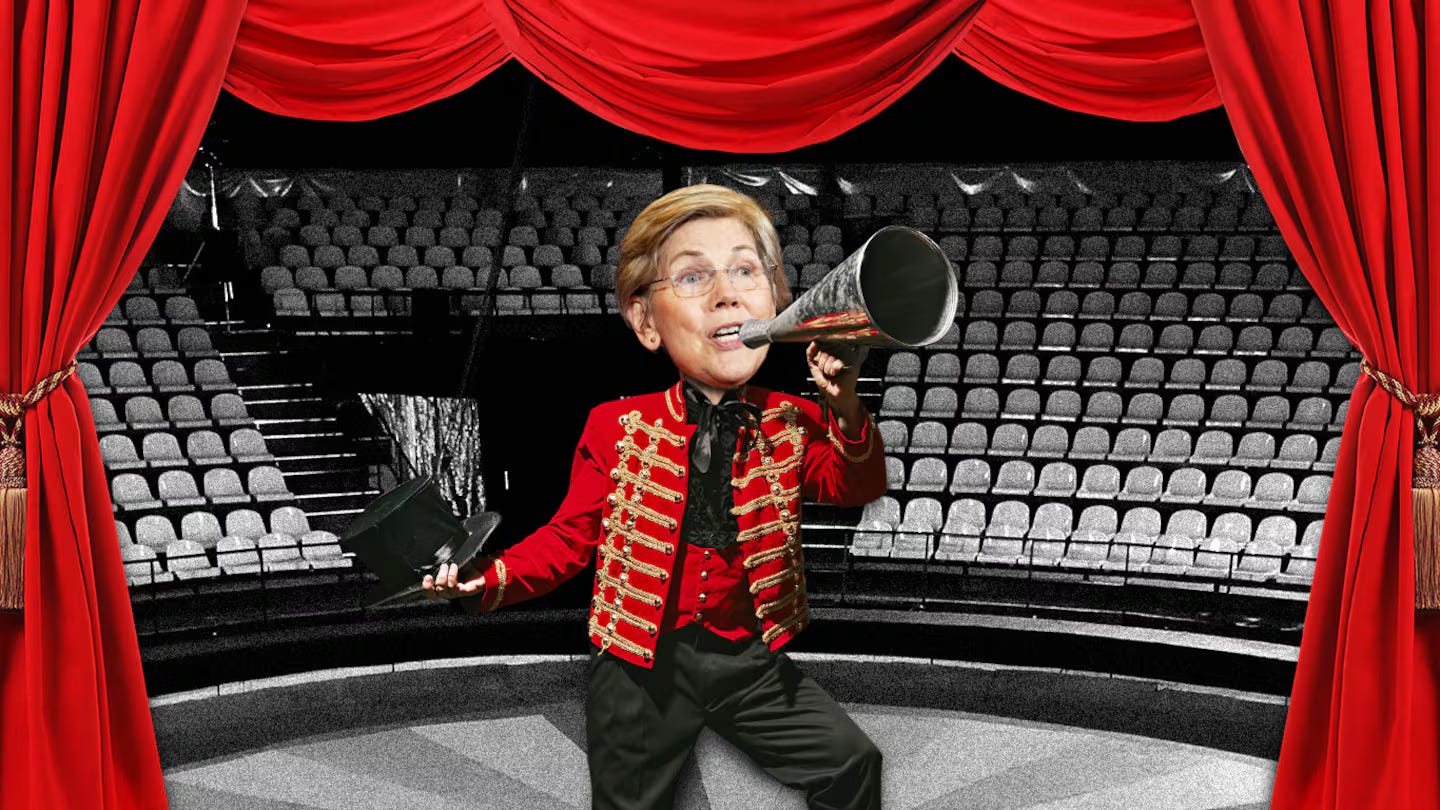
Senator Elizabeth Warren made the most recent pitch for co-opting the term in a speech at the National Press Club this week, declaring “Democrats must build a big tent based on big ideas.”
“There are two versions for what a big tent means,” Warren said. “The Democratic Party cannot pursue both visions at the same time. Either we politely nibble around the edges of change or we throw ourselves into the fight.”
“Throwing ourselves into the fight,” for Warren, means pushing to hike the minimum wage, to strengthen unions, and to raise taxes on the wealthy. And these are fine ideas. But they are not as radical as she suggests.
Most moderate Democrats support them, too.
The trouble with Warren and other progressives’ plans for building a big tent is that they leave out the hard part: meeting middle-of-the-road voters where they are on social issues. Tolerating the American majority’s moderate — even conservative — views on issues like immigration, energy, and gender.
A party that’s unwilling to abide people with these views — a party that doesn’t enthusiastically embrace these people — will have a difficult time building lasting majorities.
This can be difficult to reckon with from inside the Democratic Party, which has moved left over the years. According to Gallup, the share of Democrats identifying as liberal climbed from 33 percent in 2005 to 59 percent in 2025.
The challenge: Among voters overall, the share identifying as liberal is just 28 percent.
Liberals are numerous enough to win Democratic primaries but nowhere near enough to win general elections.
The party’s liberal turn hasn’t just cost it elections; it has spurred worrisome defections by moderates and people of color.
From 2012 to 2024, Democratic support grew by 1 percentage point among liberals and 4 percentage points among college-educated white voters but dropped by double digits not only among self-identified moderates but also among Black, Asian, and non-college-educated Latino voters.
Yes, voters of all races moved toward Democrats in lower-turnout races throughout 2025. But it would be foolish to assume that trend will continue moving forward.
How has the Democratic tent shrunk to the point that the party has lost ground with nearly every demographic except liberal and college-educated white voters?
Unpopular ideas, strictly enforced.
Thrilling, controversial ideas — from decriminalizing illegal border crossings and subsidized health care for undocumented immigrants to packing the Supreme Court and canceling student debt and banning the sale of gas-powered cars — permeated a Democratic ecosystem that was increasingly outsourcing party roles to unaccountable nonprofits and political action committees.
From 2012 to 2024, the share of Congressional Democrats sponsoring bills on issues like reparations and an assault weapons ban jumped from a minority to a majority. In the party platform, mentions of “fathers” and “responsibility” and “tax cuts” all dropped 67 percent or more in this period, while mentions of “guns” increased 725 percent (and this was not praise for hunters). Use of the initialisms “LGBT/LGBTQI+” jumped 1,044 percent.
Voters noticed.
During President Obama’s second term, fewer than half of voters said the Democratic Party is “too liberal.” By 2025, it was more than 55 percent.
According to Pew Research, voters have favored Republicans not just on the economy but also on immigration, gun policy, and crime. Even with backlash to Trump’s second-term extremism driving down his overall popularity and demonstrating backlash against specific policies like intense ICE enforcement and tariffs, Democrats have still not dug out of the hole. Some polling shows a continued Republican advantage on the economy and several surveys give the GOP an enduring edge on immigration. Republicans have also excelled at raising the salience of niche wedge issues like youth trans sports and requiring voter ID — a policy supported by more than 8 in 10 Americans.
Meanwhile, progressive activists have excelled at enforcing litmus tests on these and other issues. It was an ACLU candidate questionnaire in the 2020 Democratic presidential primary that prompted Kamala Harris to declare her support for taxpayer-funded gender-affirming surgery for inmates and immigrant detainees — a position that led to the Trump campaign’s famous “Kamala Harris is for they/them” attack ad in 2024.
A few years ago, when a pair of moderate Democrats voted against Warren’s plan to forgive student debt, nonprofits pounced. Representative Marie Gluesenkamp Perez of Washington faced attacks from so-called “dark money” nonprofits, and her family’s auto shop was inundated with bad Yelp reviews. Resistance nonprofits like Indivisible attacked center-left members of “problematic caucuses” like the Blue Dogs and Problem Solvers. Another progressive nonprofit pledged to have paid protesters harass then-West Virginia Senator Joe Manchin to ensure he did not get “any peace.”
Admitting the problem is step one. Democrats are losing moderate and conservative voters of all races, are perceived as too liberal, and have an efficient army of allied groups enforcing unpopular litmus tests.
Step two is learning from the candidates who have been able to win over swing voters. In both parties, successful politicians have taken positions that sharply differentiate them from their own party. Just look at prochoice Republican Charlie Baker, the former Massachusetts governor, who in 2018 earned more votes than Senator Warren in a deep blue state.
Step three is putting the lessons of these crossover winners into practice. To do that, the moderate proponents of a classic big tent strategy will have to admit to being in their party’s minority and wage an insurgency.

Fighting progressive activists is not the most natural approach for centrists aspiring to big tent politics. My colleagues at Welcome, a community of Democrats focused on winning congressional districts that voted for Trump, have engaged hundreds of candidates and activists working to depolarize our politics. Their approach actually looks more like classic liberalism: practicing tolerance, respect, and compromise in the face of toxicity from both left and right.
But building a big tent does require pushing back on the pugnacious ideologues in both parties.
We have studied and interviewed dozens of candidates who have built big tents in their own communities, with the election results to prove it. Democrats need to learn from these depolarizers, and their party will not achieve a majority as long as elected officials from deep-blue districts continue to set party priorities in sync with the progressive nonprofits that enforce unpopular litmus tests.
After Warren mentioned only economic issues in her speech, she was asked, “Should the Democratic Party be willing to compromise on social issues” including guns and immigration?
Warren pivoted away from the question by reiterating her focus on economics, a practice known as the politics of evasion.
Building a big tent requires rejecting such dodges. Like it or not, compromise and tolerance are at the core of democracy. Those principles require their own enforcers — or we’ll be left with nothing more than a circus.
This article originally appeared on BostonGlobe.com on Jan. 16, 2026.
 | A guest post by
|